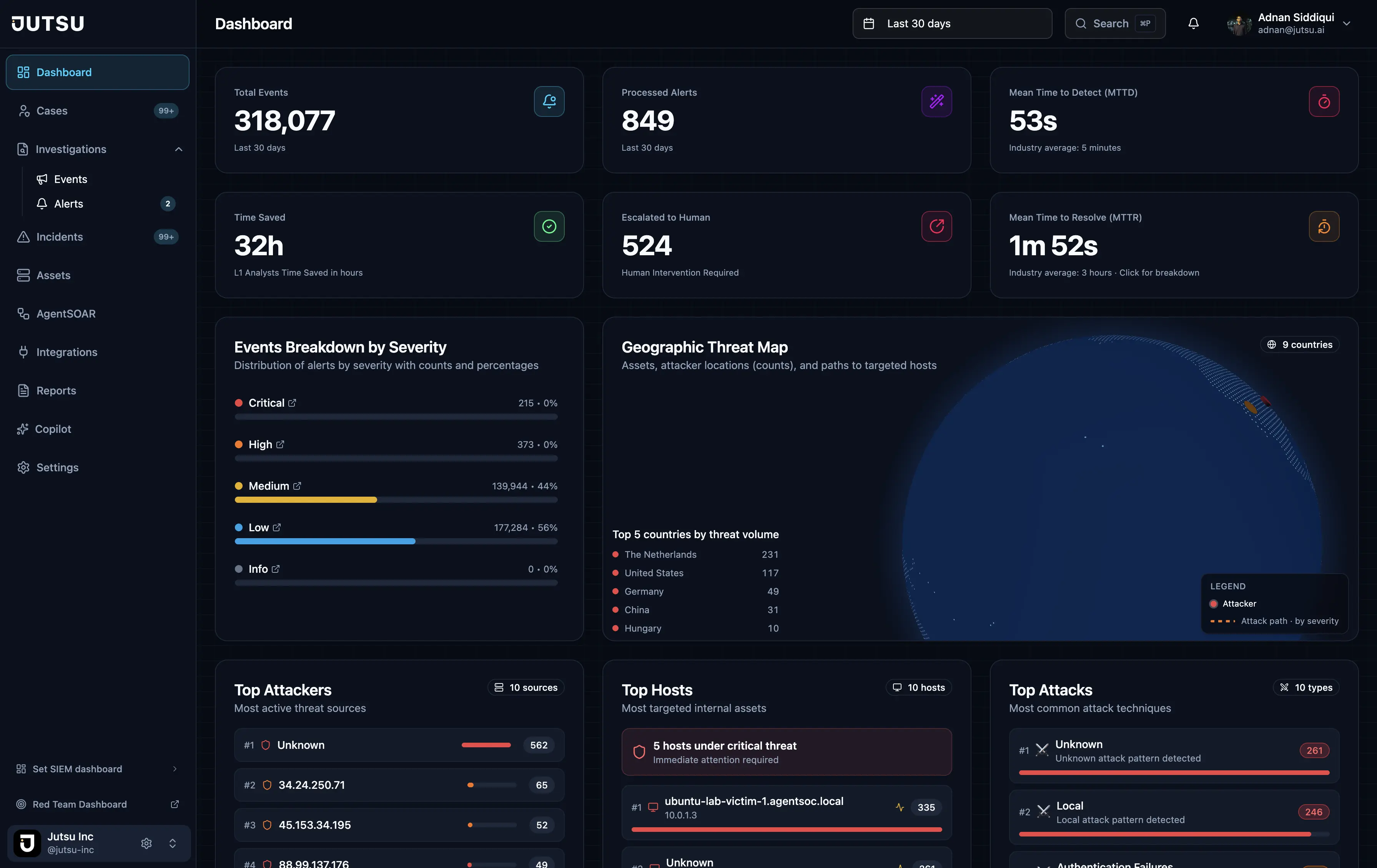
What a SIEM does, and what it doesn't
A SIEM (security information and event management) collects logs from your systems, keeps them, lets you search them, and raises alerts when a rule matches. That covers collection and detection. It leaves the review: someone has to open each alert, decide whether it's real, and act.
That's why the question small teams end up asking is rarely which SIEM. It's who will watch it. A SIEM nobody reads produces alerts and a storage bill, and little else.
Do you need a SIEM for SOC 2?
No. The SOC 2 criteria don't name a product. CC7.2 asks you to monitor your systems for unusual activity and analyze it, and your auditor will ask for evidence that it happened across the audit period: log sources, alert rules, and alert records with what was decided. A SIEM is one way to produce that, if someone does the deciding. SOC 2 continuous monitoring goes through each criterion.
How Jutsu covers both: the logs and the review
Jutsu collects events from the systems a startup runs, such as AWS, Google Workspace, GitHub, Vercel, Supabase, and laptops, and runs built-in detection rules for each one. Its AI agents then check every alert: a category, severity, risk score, and verdict, with threat intelligence attached and related alerts grouped into one incident.
When an alert is real, Jutsu proposes the fix, such as blocking an IP, disabling a user, or revoking a key. On the Startup plan a person on your team approves it first, and on Growth your own policies can let routine fixes run. Every action is logged and can be undone.
Prices are on the website, monthly or annual, with no seat minimum: Free ($0/month), Startup ($149/month), Growth ($499/month), Enterprise (custom quote). The Free plan covers 5 assets and 1 data source with no credit card.
Jutsu next to a self-run SIEM or an MDR
Running an open-source SIEM such as Wazuh yourself costs little in software, but your team installs it, tunes the rules, and reads every alert. If Wazuh already runs, keep it: Wazuh AI SOC shows how Jutsu triages its alerts.
An MDR puts people on call, usually with seat minimums and annual terms. Huntress, for example, lists a 50-seat minimum per product and a 12-month term for direct buyers (checked Nov 2026). Jutsu sits between the two: AI does the reading around the clock, your team makes the decisions, and you pay monthly. Jutsu vs Blumira covers a per-employee SMB SIEM.
When Jutsu isn't the right fit
Jutsu is software, so nobody at Jutsu watches your alerts at night, and it has no endpoint protection (EDR). If you need either, an MDR is the better buy. Splunk, Microsoft Sentinel, CrowdStrike, and Elastic connectors are on the roadmap, not live.
SIEM for SaaS startups: what to send it first
Whatever you choose, start with the place everyone signs in (Google Workspace or Microsoft 365), then the cloud account that runs the product, then GitHub, then the platforms you deploy on. Security monitoring for startups lists the events worth an alert in each one.
Looking for a Wazuh alternative?
If Wazuh already runs, you don't have to replace it: a forwarder on the Wazuh manager sends its alerts to Jutsu, where they're triaged with everything else. If you're looking for an alternative because nobody has time to run it, connect your cloud and SaaS accounts to Jutsu directly, and install the Jutsu agent on laptops and servers.