Solutions/SOC 2 for startups

SOC 2 readiness for startups, backed by real security work.

A SOC 2 audit asks for proof that your security controls run. Jutsu monitors your systems, records investigations and response, and exports that record as evidence. Your auditor still runs the audit.

SOC 2 evidence exports from StartupAudit trail of response actionsPosture checks on connected sources
Start free
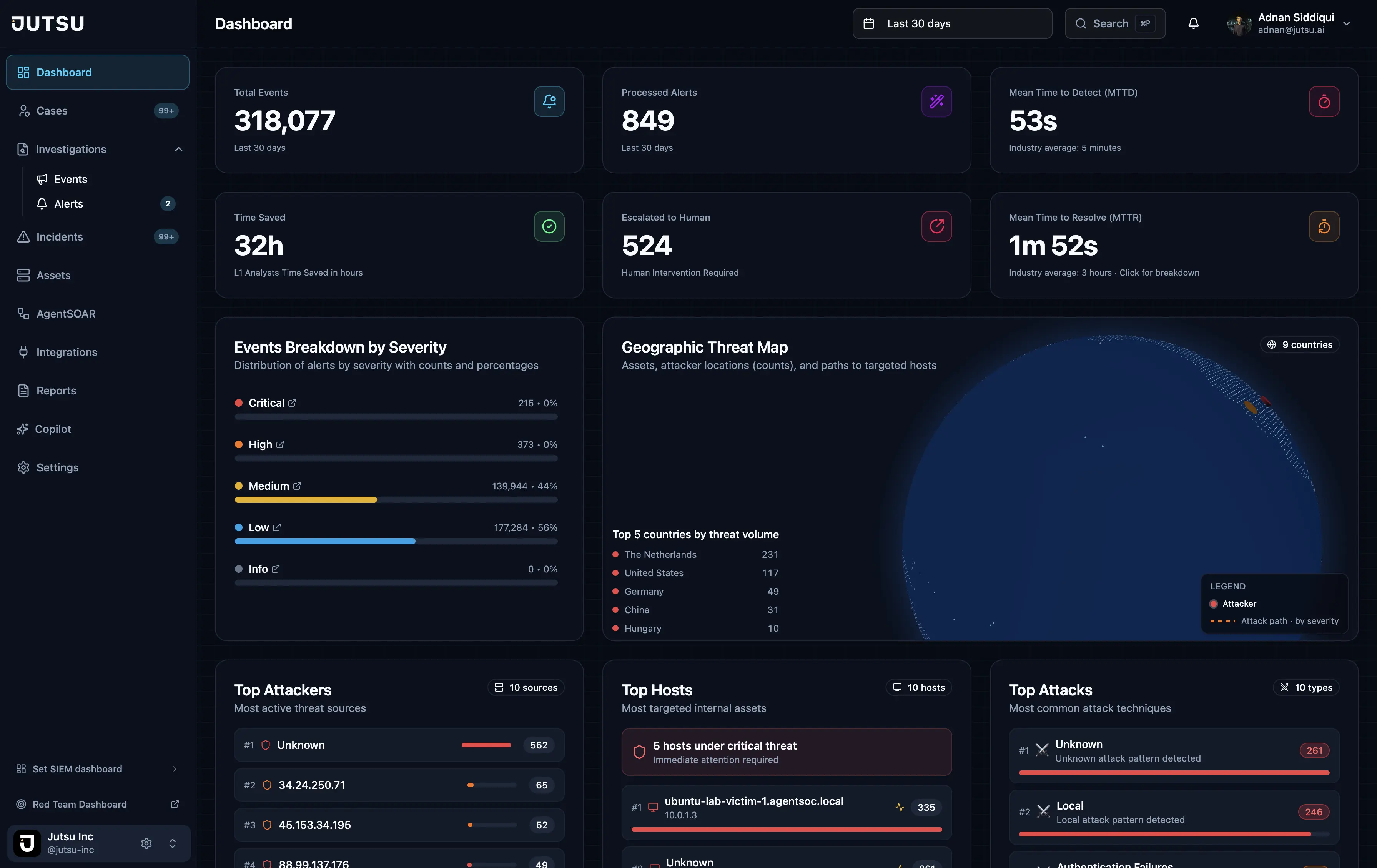
Jutsu · SOC overview
Jutsu dashboard
Monitoring that runs
Connected cloud, identity, code, and endpoint sources are watched around the clock.
Records kept for you
Alerts, investigations, and response actions are logged as they happen.
Evidence you can export
SOC 2 evidence exports are included from the Startup plan.
The audit stays yours
Jutsu supports readiness. It is not an auditor and does not guarantee an outcome.
Guide

What is SOC 2 for a startup?

SOC 2 in plain terms

SOC 2 is an attestation report on how a company protects customer data. An independent auditor, a licensed CPA firm, examines your controls against the Trust Services Criteria published by the AICPA and writes a report you can share with customers.

Security is the one criterion every SOC 2 report covers. Availability, processing integrity, confidentiality, and privacy are optional, and are added when they matter to your customers. Startups usually meet SOC 2 when a larger customer's security review asks for it.

Type I and Type II

A Type I report looks at whether your controls are designed properly at a point in time. A Type II report looks at whether they operated effectively over a period, commonly three to twelve months.

Type II is the reason monitoring matters. Saying you watch for security events is not enough. You have to show that you did, across the whole period.

What an auditor asks about security operations

Among the security criteria, the system operations requirements cover how you detect, evaluate, and respond to security events. In practice an auditor asks questions like these.

  • How do you detect security events in your systems?
  • How do you decide which events are incidents?
  • How do you respond, and who approves it?
  • Can you show records of that happening during the audit period?

What Jutsu contributes

Jutsu does the monitoring, investigation, and response work, and keeps the record of it.

  • Monitoring: connected Google Cloud, Google Workspace, GitHub, Windows host, Cloudflare, Vercel, and Railway sources are watched around the clock.
  • Triage and investigation: each alert gets a category, severity, risk score, and verdict, and uncertain ones are escalated to a person.
  • Response records: every AgentSOAR execution is recorded with its status, and approval-based response is included from the Startup plan.
  • Reports: incident reports and SOC activity reports, daily and weekly on the Startup plan.
  • Posture checks: read-only compliance posture checks for connected Google Cloud projects and Google Workspace domains, and osquery on Windows hosts, on plans that include compliance.
  • Evidence exports: SOC 2 evidence exports from the Startup plan, with continuous compliance evidence and compliance dashboards on Growth.

What stays with you and your auditor

SOC 2 covers more than security operations. Jutsu's part is monitoring, response, and the evidence that comes from them. The rest stays with your team, your auditor, and whatever compliance process you run.

Jutsu does not issue SOC 2 reports and does not guarantee an audit outcome.

  • Written policies and procedures.
  • Risk assessment and vendor reviews.
  • People controls such as onboarding, offboarding, and training.
  • Choosing an auditor, scoping the report, and the audit itself.

How this differs from a compliance-only tool

A compliance-only platform is organized around the audit: policies, checklists, and collecting proof. Jutsu runs the security work itself and uses the records of that work as evidence. The two do different jobs: one tracks the program, the other does the monitoring the program promises.

Evidence

From security work to SOC 2 evidence.

What an auditor asks, what Jutsu does, and what you can show for it.

An auditor asksWhat Jutsu doesWhat you can show
How do you detect security events?Monitors connected cloud, identity, code, and endpoint sources around the clock.The connected sources and the alerts raised from them.
How do you evaluate them?Triages each alert with a category, severity, risk score, and verdict, and correlates related alerts into incidents.Triage verdicts and incident records.
How do you respond?Runs or recommends response through AgentSOAR, under your approval or policy.Execution history with status, including reverted actions.
Who is accountable?Escalates uncertain alerts to a person, with owner, admin, member, and analyst roles.Escalations and case history, with comments and evidence.
Is your configuration sound?Runs read-only posture checks on connected Google Cloud and Google Workspace, and osquery on Windows hosts.Compliance posture results, on plans that include compliance.
Can you prove it over time?Writes incident reports and SOC activity reports. The Startup and Growth plans keep data for 365 days, with 90 days searchable.Reports and SOC 2 evidence exports, from the Startup plan.

Jutsu supports readiness and evidence collection. Your team and your auditor remain responsible for the audit, and Jutsu does not guarantee an audit outcome.

How it works

Three steps, end to end.

1

Connect the systems in scope

Connect the cloud, identity, code, and endpoint sources your SOC 2 scope covers.

2

Let the record build

Monitoring, triage, and response run around the clock, and every step is logged.

3

Export evidence for your auditor

Pull incident reports, SOC activity reports, and SOC 2 evidence exports when you need them.

Capabilities

What Jutsu gives you for SOC 2.

24/7 security monitoring

Connected sources are watched around the clock by AI agents.

Audit trail

Alerts, investigations, escalations, and response actions are recorded as they happen.

Incident and SOC reports

Incident reports and SOC activity reports, daily and weekly on the Startup plan.

Compliance posture checks

Read-only checks on connected Google Cloud and Google Workspace, and osquery on Windows hosts, on plans with compliance.

SOC 2 evidence exports

Included from the Startup plan. Growth adds continuous compliance evidence and compliance dashboards.

Retention for the audit period

The Startup and Growth plans keep data for 365 days, with 90 days searchable.

FAQ

Common questions.

Build your SOC 2 evidence from real security work.

Start on the Free plan to see the workflow, or book a demo. Evidence exports start on the Startup plan.

Start free

Subscribe to our newsletter

Get the latest security tips, product updates, and news delivered to your inbox.