
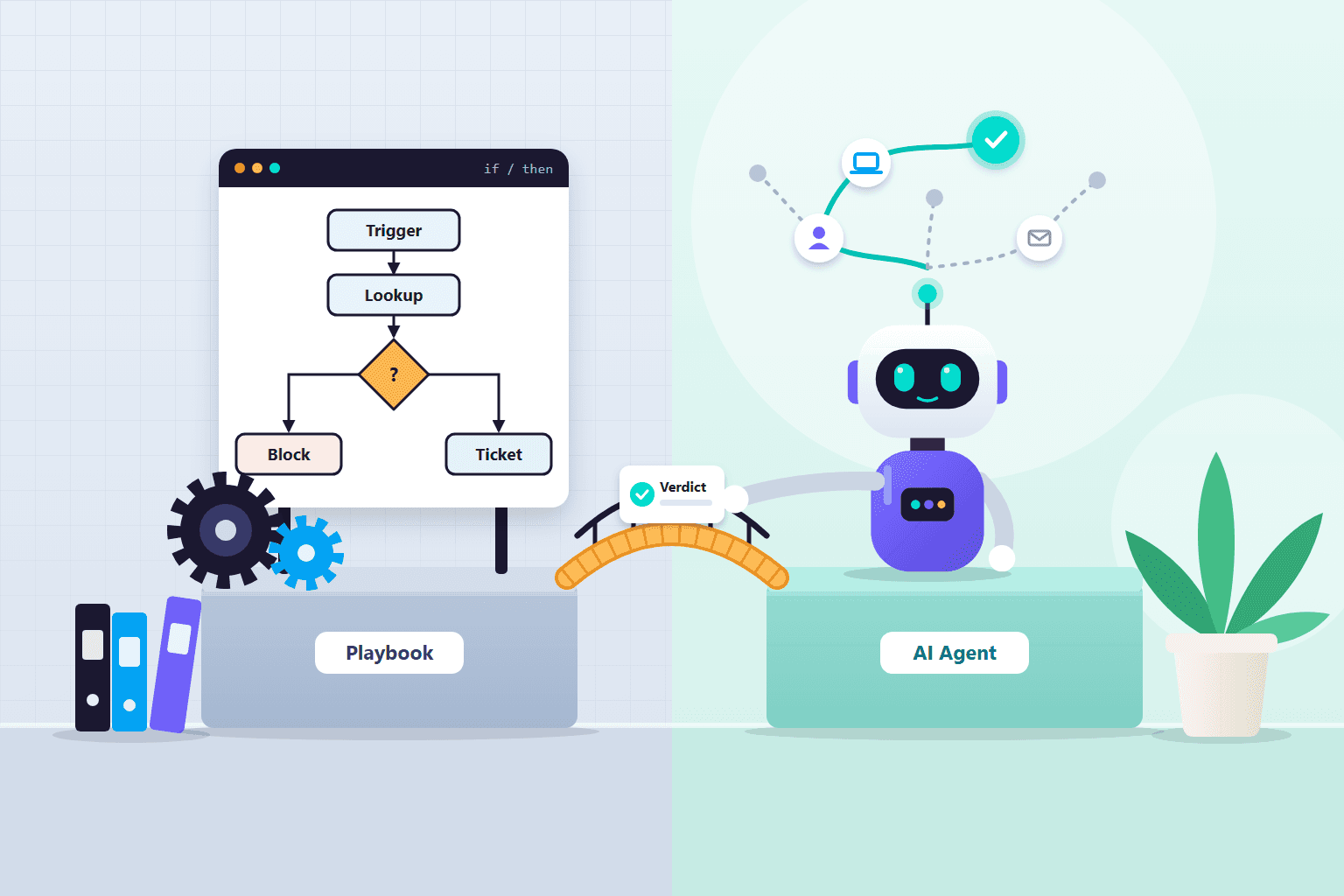
AI SOC vs SOAR comes down to how decisions get made. A SOAR platform runs deterministic playbooks that engineers write in advance, while an AI SOC uses agents that investigate each alert at runtime and reason toward a verdict, including alerts nobody wrote a playbook for. Most teams that get this right end up with both: agents doing triage and investigation, and deterministic, approval-gated actions doing the response.
Key takeaways
- SOAR executes what you predicted. AI agents investigate what you did not.
- SOAR’s biggest cost was rarely the license. It was the engineering time to build and maintain playbooks and connectors.
- SOAR still wins for fixed, compliance-bound, and high-blast-radius actions.
- AI agents win at triage and investigation of variable alerts, where context decides the verdict.
- The market is converging on a hybrid: agents decide, deterministic actions execute, and risky actions wait for human approval.
What SOAR is, and what an AI SOC is
SOAR (security orchestration, automation, and response) is a workflow engine for the SOC. It connects to your tools through APIs and runs playbooks: predefined steps with branching logic. An alert arrives, the playbook enriches indicators, checks conditions, and acts or opens a ticket. A person wrote every branch.
An AI SOC puts AI agents in the analyst seat for the first pass. The agent reads the alert, decides what evidence it needs, queries the SIEM, identity provider, EDR, or mail system, and returns a verdict with its reasoning, working within the tools and permissions you grant. For more, see what an AI SOC is.
Put simply: SOAR automates a process. An AI SOC automates a judgment, then ideally hands the action to something that behaves like SOAR.
A short history of SOAR, and why teams struggled
SOAR grew out of a real problem: too many alerts, too many consoles, and analysts copying indicators between tabs. Orchestration promised to automate the repetitive parts, and large vendors bought in fast. Splunk acquired Phantom in 2018, and Palo Alto Networks agreed to buy Demisto for $560 million in 2019.
Many deployments delivered real value on narrow, repeatable work like phishing triage and indicator blocking. The cost was in keeping them running. In a 2024 SANS survey on SOC automation, about 68% of respondents named the engineering effort to deploy and maintain automation as SOAR’s most challenging attribute, and 48% cited software costs. Later that year, Gartner’s 2024 Hype Cycle for Security Operations listed SOAR as “obsolete before plateau” and lowered its benefit rating from high to moderate, citing maintenance effort, fewer vendor options after acquisitions, and cost.
In practice, the pain showed up in three places:
- Playbook maintenance. Every new alert type or process change meant a new playbook or branch. Libraries grew, owners moved on, and nobody was sure which playbooks still fired.
- Brittle integrations. When a vendor renames a field or deprecates an endpoint, a playbook can fail silently or take the wrong branch.
- Engineering headcount. Good SOAR programs needed people who write Python and design workflows, and many SOCs could not hire them.
Deterministic automation is expensive to extend to work that is not deterministic, and most alert triage is not. That gap is what the AI SOC vs SOAR debate is really about.
How AI SOC agents work differently
An agent runs a loop, not a script. It forms hypotheses about the alert, picks a tool call to test one, reads the result, and decides what to check next. It stops when the evidence supports a verdict, or when it hits a limit and escalates. Our piece on the agentic SOC covers the architecture.
SOAR playbooks vs AI agents: one suspicious login, two ways
The alert: a successful sign-in for a finance user from a country she has never logged in from, 40 minutes after a sign-in from her usual city.
The SOAR playbook does what it was built to do:
- Trigger on the “impossible travel” alert type.
- Look up the source IP in two reputation services.
- If the IP is flagged, disable the account and open a high-priority ticket.
- If it is clean, message the user (“Was this you?”), wait 30 minutes, then escalate if there is no reply.
This works when the attacker uses a known-bad IP. It struggles when the IP is a clean residential proxy, when the “foreign” sign-in is the company’s new VPN exit point, or when the user replies “yes” without reading. It never checks what happened after the login, because nobody wrote that branch.
The AI agent asks different questions. Is the device managed? Which MFA method was used? Is the network a hosting provider? What did the session do next? Suppose it finds an unmanaged device, a hosting-provider network, and a new inbox rule forwarding invoices externally six minutes after login. It returns a verdict of likely account takeover, lists the evidence, and recommends revoking sessions, removing the rule, and resetting credentials. If it instead found a managed laptop on the corporate VPN with normal activity, it would close the alert as benign and record why.
The advantage is adaptation, not speed: nobody had to anticipate the inbox-rule branch.
AI SOC vs SOAR: side-by-side comparison
| Dimension | SOAR playbooks | AI SOC agents |
|---|---|---|
| Decision logic | If/then branches written in advance | Reasoning over evidence gathered at runtime, within granted tools and permissions |
| Novel alerts | Default path or a human, until someone writes a playbook | Investigated without a prewritten path; quality depends on data access and context |
| Setup | Connectors plus one playbook per use case; coverage grows one workflow at a time | Connect data sources and actions, set policies; coverage starts broad, accuracy improves with tuning |
| Maintenance | Playbooks and connectors break when APIs, fields, or processes change | Context, policies, and guardrails need upkeep; model changes can shift behavior |
| Auditability | Every branch can be reviewed before it runs | Each run leaves an evidence and reasoning trail; audit outcomes after the fact and sample them |
| Determinism | Same input, same output | Same input can take different paths; outputs need ongoing evaluation |
| Cost model | License plus automation engineering headcount | Usually volume-based (alerts, investigations, data, or assets); compute rises with investigation depth |
| Skills needed | Python, APIs, workflow design | Detection knowledge, evaluation design, policy writing |
| Typical failure mode | Silent breakage, stale logic, uncovered alerts dumped on analysts | Confident wrong verdicts, missed context, manipulation via attacker-controlled data, over-permissioned actions |
| Best at | Repeatable, well-defined, high-volume actions | Triage and investigation of variable alerts |
Note the failure modes. When a playbook breaks, you can trace the exact branch that went wrong; a wrong agent verdict can look confident and well argued, which is why sampling and analyst review matter.
Where SOAR still wins
- High-blast-radius actions. Disabling a privileged account, isolating a production server, or purging a message from every mailbox. You want the same scoped steps every time.
- Compliance-bound procedures. When policy requires a documented, fixed sequence (evidence preservation, notification steps), a deterministic workflow is easier to defend than a reasoning trace.
- High-volume, well-understood tasks. Blocklist syncs, ticket creation, and notifications. Reasoning adds cost and variance here without adding value.
- Cross-team IT workflows. Joiner, mover, and leaver steps are process automation, not judgment.
- Playbooks that already work. If a playbook fires reliably and has an owner, keep it.
Where AI agents win
- Triage of variable alerts. Identity, cloud, and email alerts where the same signal is benign in one context and an intrusion in another.
- The long tail. Low-volume alert types that never justified a playbook and sit in a queue.
- Multi-source investigation. Combining sign-in history, device posture, mailbox activity, and threat intelligence into one assessment.
- Consistent overnight coverage. The same investigation depth at 3 a.m. as at midday, with the case summary written as it goes.
The hybrid model: agents decide, deterministic actions execute
Agents handle judgment: triage, investigation, verdict, and a recommended response. A fixed catalog of tested, deterministic actions handles execution; the agent chooses from it but cannot invent new actions. Framed this way, SOAR vs AI agents stops being an either/or choice.
The guardrails map closely to OWASP’s guidance on excessive agency in LLM applications:
- Minimal actions and least privilege. Expose only the actions the agent needs, with narrowly scoped credentials.
- Human approval for high-impact actions. Tier actions by blast radius (below).
- Authorization outside the model. Enforce limits in the action layer, not the prompt, so an agent misled by attacker-controlled text still hits a hard boundary.
- Reversibility and logging. Prefer actions with a tested revert path, and log evidence, reasoning, action, and approver.
| Tier | Examples | Execution |
|---|---|---|
| 0: No risk | Enrichment, tagging, tickets, notifications | Automatic |
| 1: Narrow and reversible | Block one external IP, quarantine one message, revoke a standard user’s sessions | Automatic, with revert and review |
| 2: Disruptive | Disable an account, isolate a workstation, remove an OAuth grant | Agent recommends, analyst approves |
| 3: High blast radius | Privileged identities, production systems, organization-wide changes | Human-run deterministic runbook |
Gartner’s 2026 cybersecurity trends list AI-driven SOC solutions as a trend and urge human-in-the-loop frameworks for AI-supported processes. Vendors are arriving from different directions: Torq pairs agentic reasoning with deterministic workflow execution, Swimlane routes each alert to a deterministic, AI-assisted, or fully agentic path, and Dropzone positions its agents as complementary to SOAR, with verdicts triggering existing response workflows.
What “AI SOAR” means, and why vendors argue about the term
“AI SOAR” has no agreed definition, and most of the argument is about category positioning. The term gets used for at least three things:
- SOAR with AI features. Cyware, for example, describes an LLM-assisted playbook builder, AI steps inside playbooks, and a debugger for failed runs. The playbook remains the unit of automation.
- Hybrid platforms. Agents reason and route; workflows execute. Torq uses this model but rejects the “AI SOAR” label, calling itself a new category.
- A line AI SOC vendors draw. D3 Security’s “Don’t Settle for an AI SOAR” argues that a chat layer speeds up playbook writing but leaves the maintenance cycle in place, and promotes playbooks generated at runtime per incident. Simbian draws a similar line: “SOAR AI” is a playbook-first platform with an LLM added, while an AI SOC reasons about each alert without requiring a playbook.
Each position has a fair core, but behavior matters more than labels. Gartner has warned about “agent washing” (rebranding assistants, RPA, and chatbots as agents) and predicted in June 2025 that over 40% of agentic AI projects will be canceled by the end of 2027. Test the product, not the name:
- When an unconfigured alert type arrives, what happens without anyone writing anything?
- Can you see and export the evidence and reasoning behind every verdict?
- Which actions can it take alone, and is that limit enforced in the permission layer or only in the prompt?
- How does the price change when alert volume doubles?
Decision guide by team size and maturity
There is no universal winner in AI SOC vs SOAR. The right mix depends on staffing, existing automation, and risk tolerance.
| Your situation | Sensible starting point |
|---|---|
| Small team (fewer than five analysts), no SOAR, no automation engineer | An AI SOC with approval-gated response for a few reversible actions. A SOAR you cannot staff recreates the engineering burden above. |
| Mid-size team with a SOAR and a few working playbooks | Keep the playbooks that work. Put agents in front for triage and stop writing triage playbooks. |
| Large SOC or MSSP with a mature SOAR and automation engineers | Agents for triage and investigation, SOAR for execution. Expand autonomy per alert type after measuring accuracy. |
| Regulated, OT, or high-blast-radius environments | Containment stays in approved deterministic runbooks. Agents investigate and recommend; humans approve. |
| Low, stable alert volume | A SOAR or lightweight workflow tool may be enough. |
Comparing specific platforms? Our AI SOC buyer’s guide covers evaluation criteria, and our roundup of Radiant Security alternatives compares several AI SOC vendors.
Migrating from an existing SOAR
Ripping out a SOAR is rarely necessary. A staged path keeps what works:
- Inventory playbooks. Sort each into triage, response actions, or notification and ticketing. Note run frequency, failure rate, and owner.
- Pick the first alert types. Start where playbooks are weakest: variable alerts such as identity and cloud sign-in anomalies.
- Run agents in shadow mode. Agents investigate the same alerts as your analysts, without acting, for a few weeks. Compare verdicts, sampled false negatives, and time to verdict.
- Move triage first, keep actions. Retire a triage playbook once agent verdicts are reliable for that alert type. Expose response playbooks as actions the agent can request.
- Set approval tiers and enforce them in the permission layer.
- Keep measuring. Track override rate, reopened cases, and hours spent maintaining automation. That last number is where SOAR costs usually hid.
How Jutsu combines reasoning and response
Jutsu is built around the hybrid model described above. AgentSOC runs AI agents that enrich alerts with threat intelligence, triage them by severity and verdict, and correlate related alerts into incidents, with uncertain alerts escalated to analysts. AgentSOAR, the built-in response module, executes defensive actions against connected cloud, email, and identity providers such as AWS, Azure, GCP, Google Workspace, and Microsoft 365, including blocking IPs, isolating hosts, and disabling users, with a revert path. Response can be approval-based or policy-guided depending on the plan, actions are auditable, and teams that run Shuffle can trigger their own workflows.
You can review the integrations, compare plans, read the docs, or try the triage side on the free plan.
FAQ
Is SOAR dead?
No. Gartner labeled SOAR “obsolete before plateau” in 2024, citing maintenance effort, consolidation, and cost, not a lack of need for automated response. Orchestration is being absorbed into broader SOC platforms; what is fading is the standalone, playbook-for-everything model.
Can AI agents replace SOAR playbooks?
For triage and investigation playbooks, often yes, once agent accuracy is measured on your own alert types. For response, agents should call deterministic, tested actions rather than replace them.
What is AI SOAR?
Usually a SOAR platform with AI features added, such as natural-language playbook building or AI steps inside workflows. Some AI SOC vendors use the term to describe what they are not. Judge products by behavior, not the label.
Do I still need a SOAR if I buy an AI SOC platform?
If the platform includes response actions for the systems you run, with approvals and audit logs, many teams can skip a separate SOAR. If you depend on complex cross-team IT workflows or compliance-bound runbooks, keep the SOAR as the execution layer.
What is the best SOAR alternative for a small security team?
For a team without automation engineers, an AI SOC platform with built-in, approval-gated response usually fits better, because it does not depend on writing and maintaining playbooks. Check that it covers your identity, email, and cloud providers and shows its reasoning.