
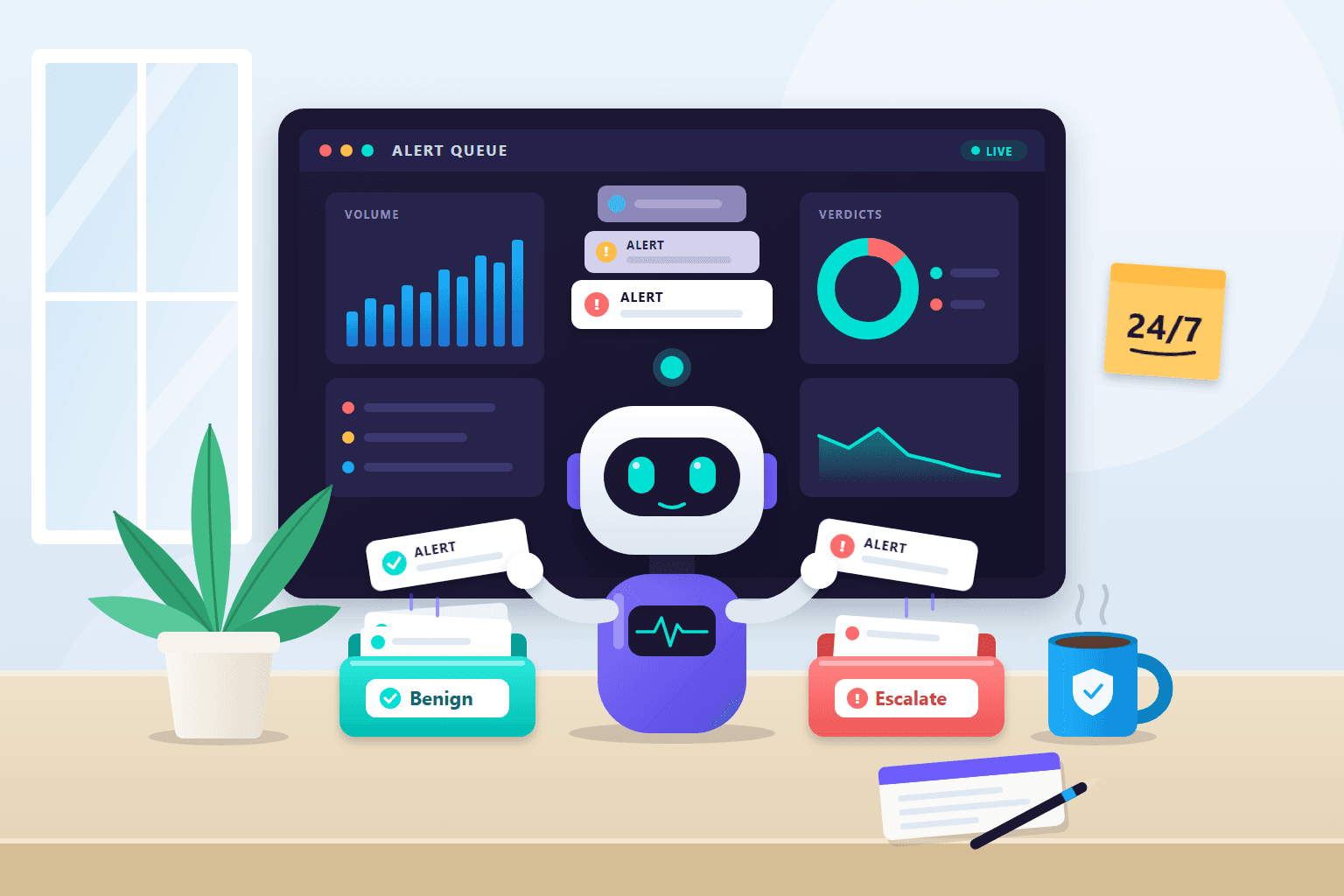
An AI SOC is a security operations center where AI does most of the repetitive analyst work: it triages, enriches, investigates, and correlates alerts, and it can take first response steps under rules your team sets. People stay in charge of policy, judgment calls, and anything with real business impact. This guide covers the problem an AI SOC solves, the three product shapes on the market, how one alert moves through the system, and where the approach still falls short.
Key takeaways
- AI takes the first pass on every alert. Analysts review its work, approve high-impact actions, and own the rules.
- The driver is volume: Vectra AI’s 2026 research found organizations receive an average of 2,992 alerts a day and leave 63% of them unaddressed.
- Products come in three shapes: copilots inside a SIEM, standalone AI analysts on top of a SIEM, and AI-native platforms that replace SIEM, SOAR, and threat intel.
- The main risks are poor input data, confident but wrong verdicts, and vendor claims that run ahead of results.
- Judge any product by measured results on your own alerts, not by a demo.
What an AI SOC actually is
A traditional SOC runs on people working a queue. A Tier 1 analyst opens an alert, pulls context from several consoles, decides whether it is real, and closes or escalates it. SOAR playbooks automated parts of that job, but only the steps someone had scripted in advance.
In an AI-driven SOC, software does that first pass. It reads the alert, decides what context it needs, gathers it, weighs the evidence, and returns a verdict with its reasoning attached. Three kinds of technology usually work together:
- Large language models read unstructured data, plan investigation steps, and write summaries a human can check.
- Machine learning models score risk, learn what normal looks like for a user or host, and flag deviations.
- Deterministic automation runs steps that must happen the same way every time, such as calling a firewall API to block an address.
Analysts stop being the first reader of every alert and become reviewers, investigators, and owners of the rules the AI follows. When the AI plans and carries out multi-step work on its own, the setup is often called an agentic SOC. Our guide to what an agentic SOC is covers autonomous agents and autonomy levels in depth; this article covers the whole category.
The problem it solves: volume, fatigue, sprawl, and staffing
AI in security operations did not take off because models got clever. It took off because the math of running a SOC stopped working.
Alert volume outgrew human capacity
Vectra AI’s 2026 threat detection research, a survey of 1,450 security practitioners and leaders, found that organizations receive an average of 2,992 security alerts per day and that 63% go unaddressed. At five minutes per alert, that is about 250 analyst-hours every day.
Fatigue pushes out the important work
The same research found that 71% of defenders set aside important security tasks at least two days a week. When triage fills the day, threat hunting and detection tuning slip first, and tired analysts start skimming. That is how a real intrusion gets closed as noise.
Tool sprawl turns analysts into the integration layer
Vectra’s respondents also reported that 69% of organizations run more than 10 detection and response tools, and 39% run more than 20. Each tool brings its own console, query language, and alert format, so the analyst ends up copying an IP address between screens to build a picture that should have been assembled for them.
Skills are scarce, and the scarce skills get buried
The 2025 ISC2 Cybersecurity Workforce Study, a survey of 16,029 professionals, found that 59% of respondents have critical or significant skills needs, and 33% say their organizations lack the resources to staff their teams adequately. Cloud investigators and detection engineers are hard to hire, and they are exactly the people you do not want spending their week on Tier 1 triage.
The three shapes of AI SOC products
Vendors use the same words for very different products. Almost everything sold today fits one of three shapes, and the shape matters more than the feature list because it decides what data the AI can see and what it is allowed to change.
| AI copilot in a SIEM | Standalone AI SOC analyst | AI-native SOC platform | |
|---|---|---|---|
| What it is | A chat assistant or AI features added to an existing SIEM or XDR | A separate product that pulls alerts from your SIEM and other tools and investigates them | One system that collects data, detects, investigates, responds, and reports |
| Who drives the work | The analyst asks; the AI answers | The AI works each alert; the analyst reviews verdicts | The AI works each alert and runs approved responses; the analyst governs |
| Data and response | Host SIEM data; response through a separate SOAR | Your existing tools via API; response through your SOAR or vendor connectors | Built-in ingestion, enrichment, and response automation |
| Change to your stack | None | Adds a layer; SIEM and SOAR stay | Replaces SIEM, SOAR, and separate threat intel tooling |
| Main strength | Faster queries, summaries, and reports | Relieves Tier 1 without moving data | Fewer tools, one data model, one audit trail |
| Main trade-off | A person still opens every alert, so the queue rarely shrinks | Sees only what other tools expose; adds cost on top of existing licenses | Migration effort; depends on the platform’s connector coverage |
| Typical fit | Mature SOCs happy with their SIEM | Teams with a working SIEM and a triage backlog | Lean teams, new SOCs, and teams consolidating a sprawling stack |
Copilots make a skilled analyst faster but do not change who reads the alert first. Standalone AI SOC analyst products relieve Tier 1 quickly, but they can only investigate what your existing tools expose; our roundup of Radiant Security alternatives compares several. An AI-native SOC removes the sprawl problem at its source, but it asks more of you up front: a migration, and confidence that the platform connects to the sources you rely on.
How an AI SOC works: one alert, end to end
Take a common case. At 02:14 on a Saturday, an internet-facing Linux web server logs a burst of failed SSH logins. One external IP tries two common passwords against 40 usernames, a pattern MITRE ATT&CK tracks as T1110.003, Password Spraying. Nine minutes later, the same IP logs in successfully as deploy, a service account.
1. Ingest
The host’s security agent or syslog forwarder ships the authentication events and the detection rule that fired. The platform receives them within seconds, at 2 a.m. the same as at 2 p.m.
2. Normalize
Raw log lines become structured fields: source IP, host, username, outcome, timestamp, rule ID. A common schema is what later lets this SSH login be compared with a cloud console login for the same account.
3. Enrich
The system checks the IP against several threat intelligence feeds (reputation, abuse reports, known mass scanners) and adds geolocation. Then it adds internal context: the host is tagged as production, and deploy normally logs in only from the CI runner’s address range.
4. Score
Each fact moves the risk score. A scanner hammering SSH is background noise every public server sees. A successful login from that scanner to a service account that never logs in from outside pushes the score to critical.
5. Triage
The AI records a verdict: true positive, critical severity, high confidence, with evidence and reasoning attached. The same night, dozens of failed-login alerts from scanners that never got in are closed as benign, each with a short, searchable explanation.
6. Correlate into an incident
The spray, the successful login, and follow-on alerts from the same host (a new cron job, an outbound connection to an unfamiliar address) become one incident with one timeline. The analyst reads one story instead of a dozen tickets.
7. Respond
Policy decides what runs without a human. Blocking the IP and disabling the deploy account are low-risk and reversible, so they run immediately. Isolating a production web server could take a customer-facing site offline, so the AI proposes it and pages the on-call analyst for approval.
8. Report
The incident record holds a plain-language summary, the timeline, the evidence, every action and who or what took it, and the ATT&CK mapping. The same record feeds the weekly SOC report and audit evidence.
The analyst’s first touch is a fully assembled case with containment already underway. That is the practical difference between a queue of raw alerts and an AI-run SOC.
What stays human
A well-run program is explicit about where the machine stops. People keep:
- The rules of autonomy. Which actions run automatically, which need approval, and which are never automated.
- High-impact response. Isolating production systems, locking out executives, or anything with legal or customer consequences.
- Low-confidence and novel cases. These should escalate with full context instead of getting a guessed verdict.
- Detection engineering and hunting. The AI surfaces patterns; humans decide which new detections they justify.
- Accountability. Declaring incidents, deciding on breach notification, and talking to regulators, customers, and the board.
NIST’s current incident response guidance, SP 800-61 Rev. 3, treats incident response as part of overall cybersecurity risk management under CSF 2.0 rather than a standalone technical task. That is a useful test: software can run detection and first response, but risk decisions and oversight belong to people.
Benefits and honest limitations
What you gain
- Coverage. Every alert gets investigated, not only the ones someone had time for.
- Consistency. The same steps run on every alert, at every hour, and they are written down.
- Speed to first verdict. Investigation starts when the alert arrives, not when a shift picks it up.
- Better use of senior people. Analyst time moves from repetitive triage to hunting, detection work, and incident command.
- Lower breach cost. IBM’s 2026 Cost of a Data Breach study found that companies using AI and automation in security operations cut breach costs by almost $2 million on average, yet one in four organizations had not adopted these tools. The figure covers AI and automation broadly, not one product category.
What can go wrong
- Bad input, bad output. AI cannot investigate logs you never collect. Missing identity, cloud, or endpoint telemetry leaves blind spots.
- Confident mistakes. Language models can write convincing reasoning for a wrong verdict. Require evidence for every conclusion and have a human review a sample of closed alerts each week.
- Attacker-controlled input. Usernames, email subjects, and user-agent strings are written by whoever sends them, and can be crafted to steer a model (prompt injection). Ask vendors how they keep data separate from instructions.
- Integration limits. An overlay sees only what its API access allows; an all-in-one platform sees only the sources it has connectors for.
- Unclear costs. Pricing may be per alert, per investigation, per asset, or per gigabyte. Model it against your real volumes.
- Skill erosion. If juniors never triage, you need another way to grow senior analysts. Rotate people through review and hunting on purpose.
AI SOC vs. MDR and SOC-as-a-service
MDR (managed detection and response) and SOC-as-a-service are services: a provider’s analysts and tools watch your environment, respond on your behalf, and are contractually accountable for it. An AI-driven SOC is technology that your team, or a provider you hire, operates.
The line is blurring. Many MDR providers use AI internally, so buying MDR does not mean avoiding AI; it means someone else runs it and you see outcomes rather than every step.
- Choose MDR if nobody on staff can answer an escalation at 3 a.m. and you want a provider to own response under contract.
- Choose an AI SOC platform if you want to keep data, detection logic, and response decisions in-house, with visibility into every verdict.
- Combine them if you want AI handling triage while a small on-call rotation, or an MSSP operating the platform for you, covers escalations.
Market context: where the category stands in 2026
- Gartner’s Hype Cycle for Security Operations, 2026 placed AI SOC agents at the Peak of Inflated Expectations, as reported by Help Net Security. On Gartner’s curve, a trough of disillusionment usually follows the peak before a technology matures.
- In the same coverage, Gartner analysts Craig Lawson and Andrew Davies predict that by 2028, 70% of large SOCs will pilot AI agents to augment Tier 1 and Tier 2 operations, but only 15% will achieve measurable improvements without structured evaluation.
- Gartner has warned about “agent washing,” the rebranding of assistants, RPA, and chatbots as agents. It estimates only about 130 of the thousands of agentic AI vendors are real and predicts over 40% of agentic AI projects will be canceled by the end of 2027.
- Adoption is broad but shallow. In the 2026 SANS SOC Survey, around four in five practitioners said they use AI or machine learning tools daily, but only about a third had built them into a defined workflow with governance and consistent validation.
The lesson across all four: measure results on your own data before you commit. Our buyer’s guide lays out a structured evaluation.
Who should consider one
Strong fit:
- Lean security teams of one to five people who receive more alerts than they can read.
- Companies that need around-the-clock coverage but cannot staff three shifts.
- Established SOCs with a Tier 1 backlog that want analysts hunting and engineering instead.
- MSSPs that need to serve more tenants per analyst.
- Teams paying for overlapping SIEM, SOAR, and threat intel contracts.
Fix these first:
- No reliable log collection. Get telemetry flowing before adding AI on top.
- Rules that forbid sending security data to third-party model providers, unless the vendor offers a deployment model that satisfies them.
- No clear owner. Someone must be accountable for policies, tuning, and review.
How Jutsu approaches it
Jutsu builds AgentSOC as an AI-native platform, the third shape in the table above. The aim is to replace the fragmented stack (a SIEM, a separate SOAR, external threat intel feeds, and standalone reporting) with one system. Every event that enters the platform is normalized, enriched against multiple threat intelligence sources such as VirusTotal, AbuseIPDB, AlienVault OTX, GreyNoise, MISP, and the CISA KEV catalog, then scored, triaged, and correlated into incidents. Uncertain alerts escalate to analysts, and actions are auditable and reversible.
Response runs through AgentSOAR, the built-in automation module, which executes actions such as blocking IPs, isolating hosts, and disabling users against connected providers including AWS, Azure, GCP, Google Workspace, and Microsoft 365, with the option to revert. A natural-language Security Copilot answers questions about your alerts, incidents, and cases. Current data sources include Wazuh, Google Workspace, and syslog, with more SIEM connectors on the roadmap; the integrations page has the live list.
To look closer, read the documentation, compare plans and pricing, or start on the free plan, which covers five assets with no credit card required.
FAQ
What is an AI SOC analyst?
It is software that does the first-pass work of a Tier 1 analyst: it reads each alert, gathers context from your tools, decides whether the activity is malicious, and escalates or closes it with a written explanation. Most products sold under this name sit on top of an existing SIEM.
Will AI replace SOC analysts?
Not in any near-term sense. It takes over much of the repetitive triage that burns analysts out and shifts people toward review, investigation, hunting, and detection engineering. Someone still has to set policy, approve high-impact actions, and answer for the outcome.
What is the difference between an AI SOC and SOAR?
SOAR runs playbooks a person wrote in advance: if alert type X arrives, do steps A, B, and C. An AI-driven SOC decides which steps each alert needs, including for alert types nobody scripted. Many teams use both, with AI deciding and SOAR executing. Our comparison of the two covers the details.
Can AI work with my existing SIEM?
Yes, and the product shape decides how. Copilots live inside a specific SIEM. Standalone AI analysts connect to your SIEM through its API. AI-native platforms ingest from your log sources directly and can run alongside a SIEM during a migration or replace it afterward.
How much does AI for the SOC cost?
Pricing models vary: per alert, per investigation, per protected asset, per gigabyte of data, or a flat platform fee. Ask vendors to price against your actual daily alert and data volumes, and check what happens to the bill when volume spikes during an incident.