Find and fix security vulnerabilities before they cost you

Jutsu finds the misconfigurations a pentest would flag first, checks your website and API on a schedule, and watches for real attackers 24/7. The penetration test itself comes from a pentest firm: Jutsu gets you ready for it and keeps you secure between tests.

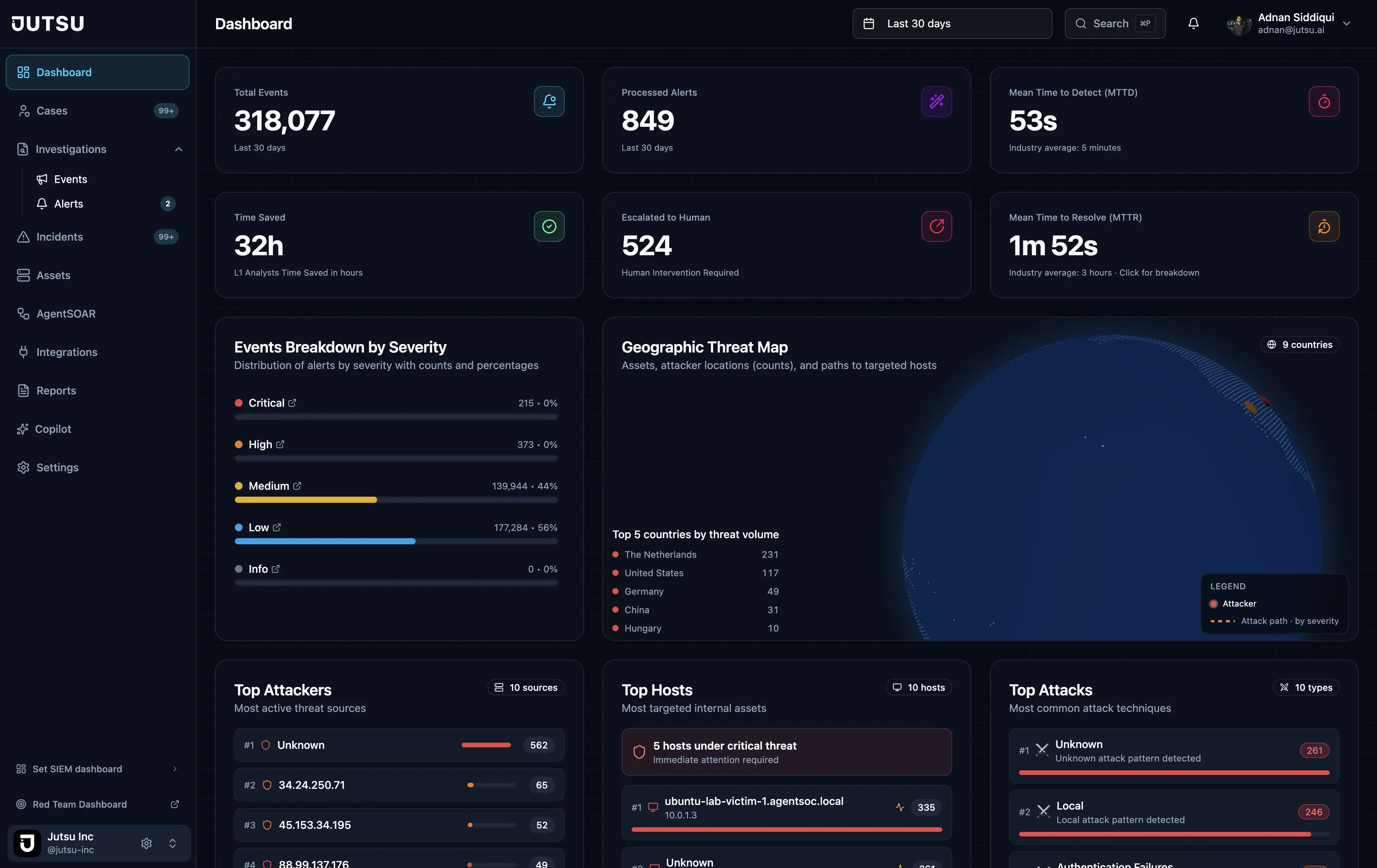
Jutsu dashboard
Jutsu · SOC overview
  • Ready before the testers arriveDaily checks on AWS, Google Cloud, Azure, and GitHub clear the easy findings first.
  • Your website and API, on a scheduleWebsite checks and OWASP API Security Top 10 assessments, on hosts you have verified.
  • Watched between tests24/7 monitoring and AI triage on the systems you connect.
  • Detections put to the testRed Team runs MITRE ATT&CK scenarios and shows what your monitoring caught.

What is a penetration test, and does a startup need one?

What a penetration test is

A penetration test is a time-boxed exercise in which security testers try to break into your application, API, or cloud account the way an attacker would, with your written permission and within a scope you agree on. Unlike an automated scan, people chain small weaknesses together and check whether each one can really be exploited. You get a report of what they found, how serious each finding is, and how to fix it.

A pentest shows how things stood while the testers were working. It isn't monitoring, and it doesn't keep you secure in the months between tests.

Where Jutsu fits around a pentest

Jutsu doesn't run penetration tests. It works on either side of one: it clears the findings that are cheap to find before you pay for testers' time, and it keeps watching after they leave.

  • Before the test: daily checks on AWS, Google Cloud, Azure, GitHub, and your deploy platforms find public storage, remote-access ports open to the internet, missing multi-factor sign-in, and the other misconfigurations testers report first. Cloud security posture assessment lists what they cover.
  • Your website and API: Application Monitoring checks a website for certificate expiry, missing security headers, exposed files, and outdated libraries. API Monitoring runs scheduled assessments against the OWASP API Security Top 10, and only on APIs you have verified you own.
  • During the test: a pentest is also a chance to see whether your monitoring notices. Jutsu shows which of the testers' actions raised an alert on the systems you have connected, and which didn't.
  • Between tests: Red Team runs MITRE ATT&CK-mapped attack scenarios against scoped, authorized targets and measures what your detections caught. It tests your detections, not your application.
  • After the test: confirm cloud fixes with Check again, and keep the monitoring and response records that support your SOC 2 readiness.

When a startup needs one

A pentest costs money and your team's time, so it pays to know what is asking for one. These are the usual triggers:

  • A customer's security review or questionnaire asks for a recent pentest report, or a summary of one.
  • A SOC 2 audit is coming. SOC 2 doesn't make a pentest mandatory, but an auditor or a customer may expect one, and the SOC 2 cost guide shows what it adds to the bill.
  • You handle card payments: PCI DSS requires penetration testing at least once every 12 months and after significant changes.
  • A big launch, or a major change to how your app handles sign-in, payments, or customer data.

What a startup pentest covers

Scope is the most important decision in a pentest. For a SaaS startup it usually includes some of these:

  • Web application: sign-in and sessions, access control between users and between customer accounts, injection, and the other risks in the OWASP Top 10.
  • API: authentication, whether one user can read or change another user's data, rate limits, and the risks in the OWASP API Security Top 10.
  • Cloud: how your AWS, Google Cloud, or Azure account is configured, who can do what in it, and what can be reached from the internet.
  • Sometimes mobile apps, internal networks, or phishing tests, when a customer or auditor asks for them.

How an engagement runs

The steps are much the same whichever firm you hire. How long the testing takes is set by the scope: one web app takes less time than an app, its API, and its cloud account together.

  • Scope: which apps, APIs, environments, and user roles are in and out, and whether testing runs against staging or against production with test accounts.
  • Permission: written authorization and rules of engagement, with who to call if something breaks, what is off-limits, and when testing happens.
  • Testing: the testers work through the scope by hand, with tools to help.
  • Report: an executive summary, then each finding with its severity, the evidence, how to reproduce it, and how to fix it. Severities are usually critical, high, medium, low, and informational, often scored with CVSS.
  • Fix and retest: you fix the findings, and the testers confirm the fixes. Ask whether a retest is in the price.
  • Something to share: ask for a summary or attestation letter you can send customers instead of the full report.

Questions to ask a pentest firm

Pentests are usually quoted per engagement, and the price follows the scope. Before you sign, ask:

  • Who does the testing, and what qualifications do they hold (OSCP and CREST are common ones)?
  • How much of the work is manual testing, and how much is an automated scan?
  • Is a retest included, and for how long after the report?
  • Can we see a sample report?
  • Will we get a summary or letter we can share with customers?
  • How do you avoid disrupting production?

Where Jutsu stops

Jutsu doesn't run penetration tests, write pentest reports, or issue attestation letters, and its automated checks don't replace a tester's judgment. When a customer asks for a pentest report, it has to come from a pentest firm.

Pentest, checks, or attack simulation?

Each answers a different question. Jutsu runs the software ones; a pentest firm runs the pentest.

ExerciseThe question it answersWho runs it, and whenIn Jutsu
Penetration testCan someone break in, and how far could they get?A pentest firm, at a point in time.Not offered. Jutsu gets you ready and keeps watch between tests.
Cloud posture checksIs the account configured safely?Software, every day.Read-only checks on AWS, Google Cloud, Azure, GitHub, and your deploy platforms.
Website and API checksDoes the app show known kinds of weakness?Software, on a schedule.Application Monitoring and API Monitoring, on hosts you have verified.
Attack simulationWould our monitoring notice an attack?Software, on demand.Red Team, with MITRE ATT&CK-mapped scenarios.
Continuous monitoringIs someone attacking us right now?Software, around the clock.24/7 monitoring, AI triage, and response your team approves.

None of the software rows replaces a pentest, and a pentest replaces none of them.

What Jutsu adds around a pentest

  • Daily posture checks

    AWS, Google Cloud, Azure, GitHub, and your deploy platforms, with a fix for each finding.

  • Website checks

    Certificate expiry, missing security headers, exposed files, and outdated libraries, with what changed since last time.

  • API assessments

    Scheduled checks against the OWASP API Security Top 10, on APIs you have verified you own.

  • 24/7 monitoring

    Security events from the systems you connect, watched around the clock, with AI triage on every alert.

  • Attack simulation

    Red Team's MITRE ATT&CK scenarios measure what your detections catch.

  • Records for audits

    Monitoring, response, and check records that support SOC 2 readiness.

Common questions

Does Jutsu do penetration testing?

No. Jutsu doesn't run penetration tests or write pentest reports. It gets you ready for one with daily cloud and GitHub checks and scheduled website and API checks, and it keeps watch between tests with 24/7 monitoring. For the pentest itself, hire a pentest firm.

When does a startup need a penetration test?

Usually when a customer's security review asks for a recent pentest report, when an auditor or customers expect one alongside SOC 2, when you handle card payments (PCI DSS requires penetration testing at least once every 12 months), or before a big launch or a major change to how your app handles sign-in, payments, or customer data.

Does SOC 2 require a penetration test?

SOC 2 doesn't make a pentest mandatory, but an auditor or a customer may expect one. Jutsu supports SOC 2 readiness with monitoring records, daily checks, and its Compliance module; the pentest itself comes from a pentest firm.

What is the difference between a penetration test and a vulnerability scan?

A vulnerability scan is automated and looks for known kinds of weakness. A penetration test is done by people, who try to exploit weaknesses and chain them together to see how far an attacker could get. A scan is broad and can run often; a pentest goes deep at one point in time.

What should a pentest report include?

An executive summary; the scope and method; each finding with its severity, the evidence, steps to reproduce it, and how to fix it; and, after a retest, which findings are fixed. Severities are usually critical, high, medium, low, and informational, often scored with CVSS.

How can we prepare for a pentest?

Agree the scope and test accounts early, and fix the cheap findings first so the testers' time goes on deeper problems: public storage, remote-access ports open to the internet, missing multi-factor sign-in, and old keys. Jutsu's daily checks find those in AWS, Google Cloud, Azure, and GitHub, and its monitoring shows which of the testers' actions raised alerts.

Is Jutsu's API Monitoring a penetration test?

No. API Monitoring runs scheduled, automated assessments against the OWASP API Security Top 10, and only on APIs you have verified you own. It finds known kinds of weakness between pentests, but it doesn't replace a tester's judgment.

Get ready for your next pentest

Get your first posture report free on the Free plan, or book a demo to see Jutsu's checks and monitoring.

Subscribe to our newsletter

Get the latest security tips, product updates, and news delivered to your inbox.