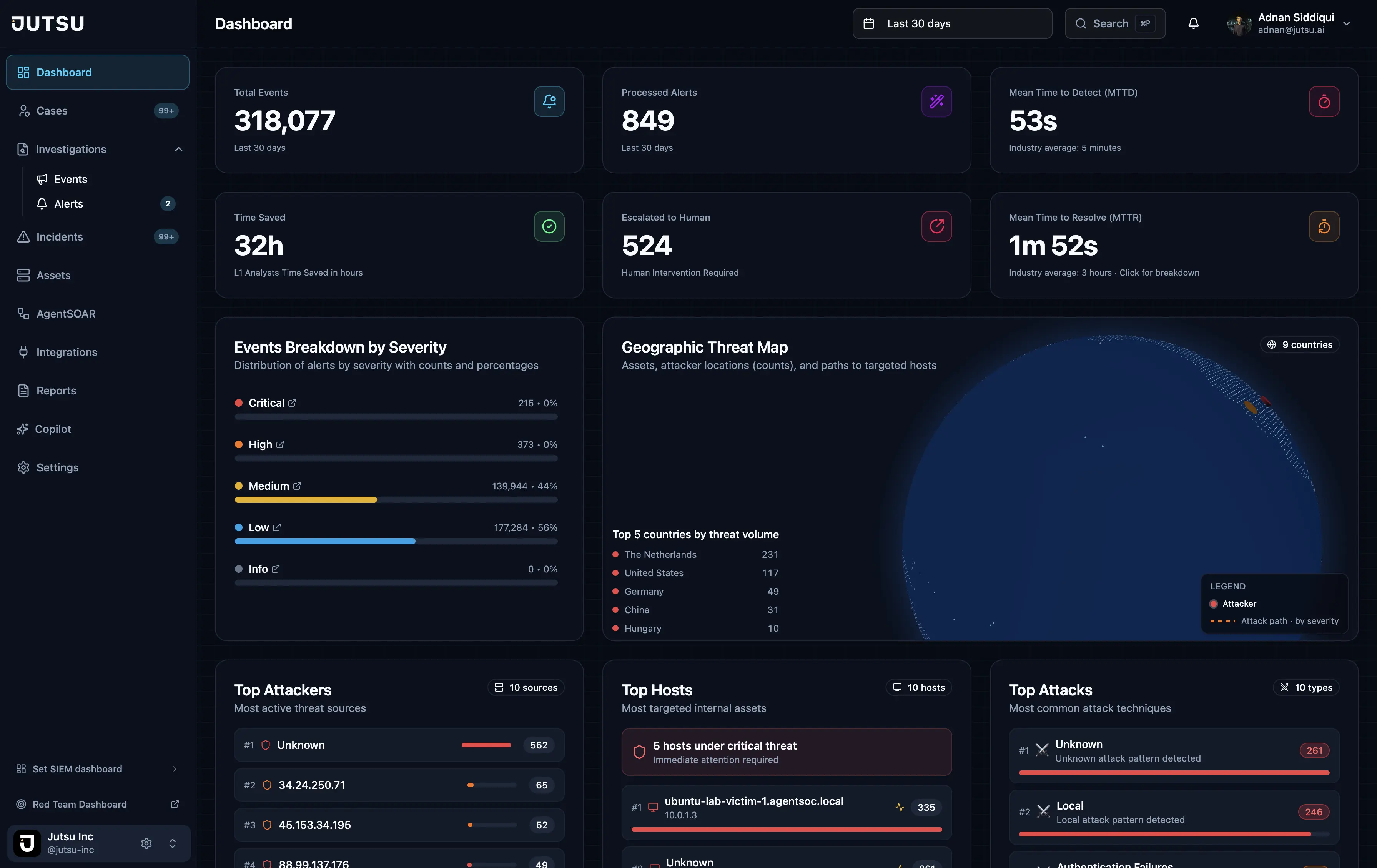
What an AI SOC platform should do
An AI SOC platform uses AI agents to do the work of a security operations center: triage alerts, investigate them, correlate them into incidents, and respond, while analysts keep the decisions that need judgment.
Feature lists across vendors rarely line up, so compare them on the work you need done:
- What the triage output contains, and what happens when the AI is unsure.
- Whether response is built in, which actions it can take, and whether they can be undone.
- Which actions can run without a person, and who sets that boundary.
- Whether the platform works with the SIEM and identity stack you already run.
- How you will prove that detections fire, and where your data will live.
- Whether pricing is public and what a pilot costs.
How we wrote this comparison
We only describe Jutsu here, and only capabilities our documentation covers. Other vendors' products change often, and we'd rather not misstate them. For each criterion, the table lists the question to ask each vendor. Ask them all the same questions, then run a pilot on your own alerts.
Where Jutsu fits, and where it doesn't yet
Jutsu fits teams that want triage, response, and reporting in one platform, with humans in control and pricing they can read before a sales call. It suits teams on Wazuh or Google Workspace especially well, because both connect today. MSSPs can run multiple client tenants on the Enterprise plan.
If your primary SIEM is Splunk, Microsoft Sentinel, or CrowdStrike, check the integrations page first: those connectors are on the roadmap, not live. Connectors for Torq and Cortex XSOAR are on the roadmap too, if you plan to run Jutsu alongside them.